
October 28, 2026
Medically Reviewed.Last updated on 04/28/2024.
Diffuse idiopathic skeletal hyperostosis (DISH) is a type of arthritis that causes your soft tissues — ligaments, tendons and joints — to stiffen and calcify. You may also get bone spurs, which can cause pain and other symptoms. Treatment is exercise and pain relief as needed. Sometimes, people need surgery to remove a bone spur.
Overview
What is diffuse idiopathic skeletal hyperostosis (DISH)?
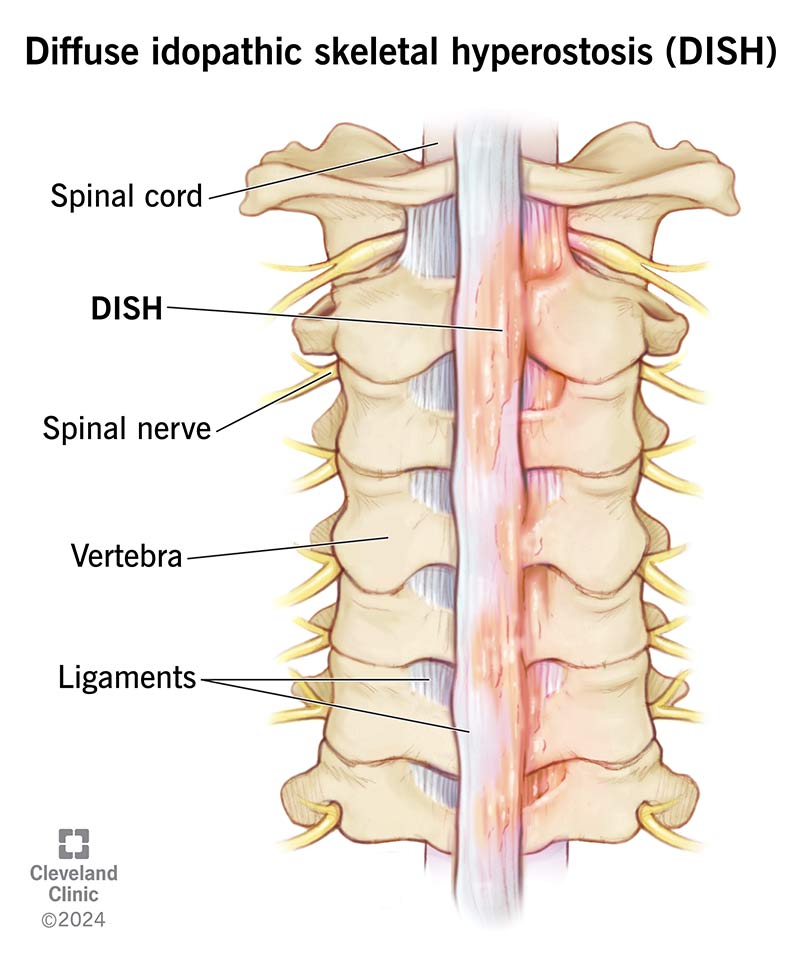
Diffuse idiopathic skeletal hyperostosis (DISH) is a type of arthritis that involves excess bone tissue growing into your soft tissues. It causes hardening and stiffness in your skeletal ligaments and joints.
“Hyperostosis” is excess bone growth. In DISH disease, calcium deposits form in the soft tissues connected to your skeleton. Calcification leads to ossification, bone tissue within your soft tissues.
“Diffuse” means that this process can occur anywhere along your skeleton. But it typically begins along your spine, particularly in the middle (thoracic) part. “Idiopathic” means it occurs for unknown reasons.
Diffuse idiopathic skeletal hyperostosis can cause musculoskeletal pain and mobility problems. Ossification can lead to bone spurs, outgrowths of bone that can interfere with how your joints move.
Is DISH disease the same thing as Forestier disease?
DISH disease is also called Forestier’s disease, after one of the doctors who first described it in 1950. Later, in 1975, Resnick and his team of researchers coined the more specific term, diffuse idiopathic skeletal hyperostosis.
How common is diffuse idiopathic skeletal hyperostosis (DISH)?
DISH is common in older populations. It rarely appears before the age of 40, but it affects up to 40% over the age of 50. It’s twice as common in males as females.
Symptoms and Causes
What are the symptoms of diffuse idiopathic skeletal hyperostosis (DISH)?
Diffuse idiopathic skeletal hyperostosis may cause general stiffness and pain, most commonly back pain and neck pain. You might notice it most in the morning and in cold weather. You’ll also notice a general loss in your range of motion.
DISH disease usually affects your spine and axial skeleton first, but it can also affect your peripheral skeleton — the parts that extend from your main trunk. You might develop joint pain or tendonitis in your:
DISH disease doesn’t always cause noticeable symptoms. When it does, it’s usually because it’s been going on for a while. It means the process has finally progressed enough to harden your soft tissues.
Sometimes symptoms begin when bone overgrowth begins to put pressure on a nearby nerve. This can cause more noticeable pain, especially when you move a certain way or press on a certain spot.
A pinched nerve may also cause:
- Numbness or tingling.
- Pins and needles.
- Muscle weakness.
If hyperostosis in your neck puts pressure on your esophagus or throat, it might cause:
What causes diffuse idiopathic skeletal hyperostosis?
Researchers are still working to understand what causes DISH syndrome. They’re looking into a variety of factors that may be involved, though they aren’t sure how yet. Some of these factors include:
- Metabolism. There’s significant crossover between DISH and metabolic syndrome, which is a group of related conditions that increase your risk for cardiovascular disease. It includes diabetes or high insulin levels, high uric acid levels, high cholesterol and obesity.
- Genetics. Many people with DISH syndrome have a genetic marker known as HLA-B8, which has been associated with many autoimmune diseases, including Type 1 diabetes. Diffuse idiopathic skeletal hyperostosis isn’t considered an autoimmune disease itself, but many people with DISH disease also have diabetes.
- Inflammation. DISH syndrome is considered a noninflammatory type of arthritis, which means it isn’t driven by automatic inflammation, as autoimmune diseases are. But there might be some low-grade inflammation involved. Inflammation might trigger the calcification process in some way.
- Growth factors. An excess of growth factors, including human growth hormone (HGH), insulin and insulin-like growth factor 1, may be related to excess bone growth in DISH (hyperostosis). Growth factors are proteins and hormones that tell your body to keep making new tissues.
What are the risk factors for developing DISH disease?
You’re more likely to develop DISH disease if you:
- Are older than 50.
- Are male.
- Have other types of arthritis.
- Have metabolic syndrome.
How serious is DISH (diffuse idiopathic skeletal hyperostosis)?
DISH syndrome doesn’t always cause problems for people. Some never notice it at all. But in more severe cases, diffuse idiopathic skeletal hyperostosis can cause some serious complications.
Some of these include:
- Neck compression. Large bone spurs on your cervical spine can compress your esophagus or throat, causing difficulties with swallowing, speaking or breathing, particularly at night. Sleep apnea can lead to chronically low blood oxygen levels (hypoxia) and put stress on your heart.
- Spinal fractures and instability. DISH disease stiffens your spine, which makes it more vulnerable to breaks. Even minor trauma (a low-energy impact) might be enough to fracture or displace one of your vertebrae. This makes your spine unstable and more prone to injury.
- Spinal cord compression. Bone thickening or large bone spurs along your spinal column can compress your spinal cord in severe cases. This can lead to nerve pain syndromes like sciatica and other nerve symptoms, called myelopathy. In the worst-case scenario, it could cause paralysis.
Diagnosis and Tests
How is diffuse idiopathic skeletal hyperostosis diagnosed?
Healthcare providers use imaging tests to look for evidence of diffuse idiopathic skeletal hyperostosis. It’ll often show up on a routine X-ray or ultrasound. A CT scan (computed tomography scan) can offer more detail if needed.
Radiologists look for “flowing ossifications,” a series of three or four vertebrae in a row that show bone overgrowth or hardening of the ligaments along the bone. It looks a bit like wax dripping from a candle.
They might look for signs of the disease in other places if you have symptoms elsewhere. Entheses, the attachment sites where joints or ligaments connect to bones, are often calcified in other places.
They’ll also look for signs that help distinguish DISH disease from other similar conditions, like ankylosing spondylitis and osteoarthritis. Sometimes, people have diffuse idiopathic skeletal hyperostosis together with these other conditions.
Management and Treatment
What treatment is available for diffuse idiopathic skeletal hyperostosis?
While there’s no cure for DISH disease, physical therapy can help relieve stiffness and improve your range of motion. A physical therapist can recommend appropriate, low-impact exercises to practice at home.
You can use over-the-counter (OTC) pain relievers, like NSAIDs, to relieve aches and pains. Your healthcare provider can also prescribe pain medications if needed. Cortisone shots can treat pain in specific areas.
Your provider will monitor your condition, looking out for possible fractures and other complications. Providers sometimes prescribe medications called bisphosphonates to prevent or help heal fractures.
If bone overgrowth or bone spurs begin to compress your nerves, causing new pain or other symptoms, you might need surgery to relieve the pressure. Bone fractures might also need surgery to repair.
Outlook / Prognosis
What is the outlook for people with DISH disease?
CLICK here to continue reading from myClevelandclinic.org
Stay in the loop
Get new articles as they publish
Join our community and we will send trusted education and updates for your condition.