
August 6, 2026
— “Serologically active, clinically quiescent” patients don’t always stay that way
by John Gever, Contributing Writer, MedPage Today
July 31, 2026
Flare prediction can be improved for patients with a common but poorly understood variant of systemic lupus erythematosus (SLE) by tracking certain biomarkers regularly, researchers proposed.
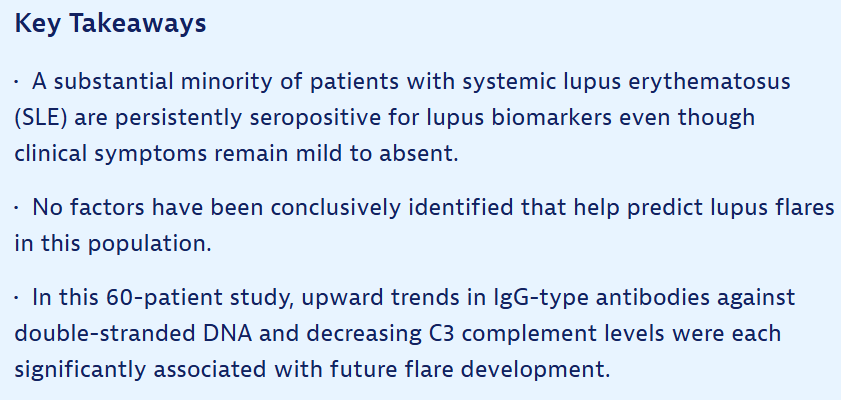
Changes in levels of IgG-type antibodies against double-stranded DNA (anti-dsDNA) and C3 complement were significantly associated with flare development in SLE patients with minimal symptoms but who continue to carry standard biomarkers for the disease, according to David Alan Isenberg, MBBS, of University College London (UCL) in England, and colleagues writing in Rheumatology.
This population of SLE patients is known by the abbreviation SACQ, for “serologically active, clinically quiescent.” It was first recognized as a distinct subgroup several decades ago and is estimated to account for 6%-25% of all SLE cases, Isenberg’s group explained. However, “quiescent” doesn’t necessarily mean total freedom from symptoms — disease flares still occur, and predicting them has been a challenge.
“Against this backdrop, the primary aim of our study was to assess whether IgG anti-dsDNA antibody and C3 levels predict flares and sustained disease activity in prolonged SACQ patients,” the researchers said. “We also investigated additional potential risk factors that might contribute to flare onset.”
They combed records of SLE patients enrolled in an ongoing observational study at UCL to identify SACQ patients, coming up with 60 who had at least 6 months of high anti-dsDNA antibody titers (>10 IU/mL) and/or below-normal levels of C3 (<0.9 g/L) while also showing minimal disease activity over the same period. The latter was defined as having British Isles Lupus Assessment Group (BILAG) index values of D or E in all domains. Mean follow-up was 3.3 years and a total of 531 clinic visits were recorded. Between-visit intervals averaged about 4 months.
Isenberg and colleagues confirmed that, despite SACQ status, clinical quiescence was only temporary in most cases — 63% of their patients developed a total of 117 flares during follow-up (any visit with a BILAG score of A, B, or C in any domain was considered a disease flare). Mean time to the first lupus flare was about 17 months. Isenberg and colleagues couldn’t identify any baseline characteristics that distinguished those with flares from the flare-free, with one exception. That was the presence of anti-Ro antibodies, seen in 58% of flare patients versus 23% of those without flare (P=0.018).
What proved more useful as flare predictors were upward movement in IgG anti-dsDNA antibody titers and downward trends in C3 levels between clinic visits. In particular, each 10-unit increase in anti-dsDNA antibodies raised flare risk by 4% (OR 1.04, 95% CI 1.01-1.08), and each 0.1-unit decrease in C3 level raised the risk by 26% (OR 1.26, 95% CI 1.11-1.43).
These same biomarkers also predicted onset of sustained disease activity, defined as two consecutive visits with BILAG scores of A, B, or C in any domain, by 8% for each 10-unit increase in anti-dsDNA antibodies and 23% for each 0.1-unit decrease in C3. These numerical associations included adjustments for potential demographic and clinical confounders, such as treatments patients were receiving.
These findings, the authors said, support monitoring SACQ patients for these markers at each regular clinic visit, with a view toward “a more personalized and timely approach to disease management, helping to reduce flare-related morbidity and long-term organ damage.”
Source: Medpage Today
Stay in the loop
Get new articles as they publish
Join our community and we will send trusted education and updates for your condition.